The flagship: 15 times cheaper in three and a half years
In March 2023, GPT-4 cost $30 per million input tokens and $60 per million output tokens. The context was 8,192 tokens — roughly ten pages of text.
In September 2026, a model of the same class, Claude Sonnet 5, costs $2 and $10, and its context is a million tokens. Input got 15 times cheaper, output 6 times, and the memory in a single conversation grew 122 times.
The floor for the working class is lower still. As of September 21, the OpenRouter catalogue lists 417 models with a price; the cheapest of those that can actually handle the work are DeepSeek V4 Flash at $0.04 per million input tokens and Qwen3.7 Flash at $0.03. That's 750 times cheaper than the 2023 flagship.
Our bill: 1,243 steps for $112.62
Price lists are rates. Work is something else. Here is our billing log for 30 days: fourteen digital employees made 1,243 working steps for $112.62. The average step cost $0.091.
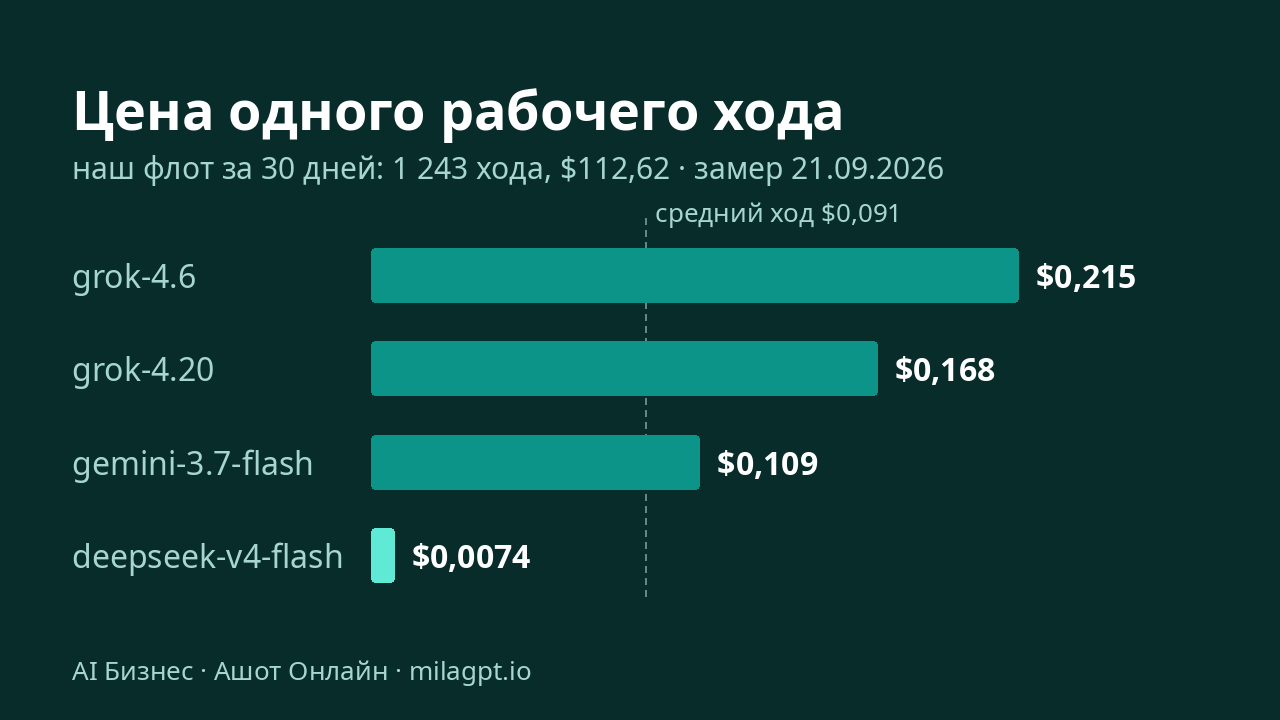
The spread matters more than the average. A step on deepseek-v4-flash costs $0.0074, a step on grok-4.6 costs $0.215. That's a 29-fold difference, and both models are alive, both are at work today.
Intelligence isn't what's expensive. Memory is
This is the most unexpected thing in our numbers. A day's work by one agent that keeps the whole business in its head costs $467.90 at API prices. A day's work by all fourteen Milas together costs $3.75. A 125-fold difference.
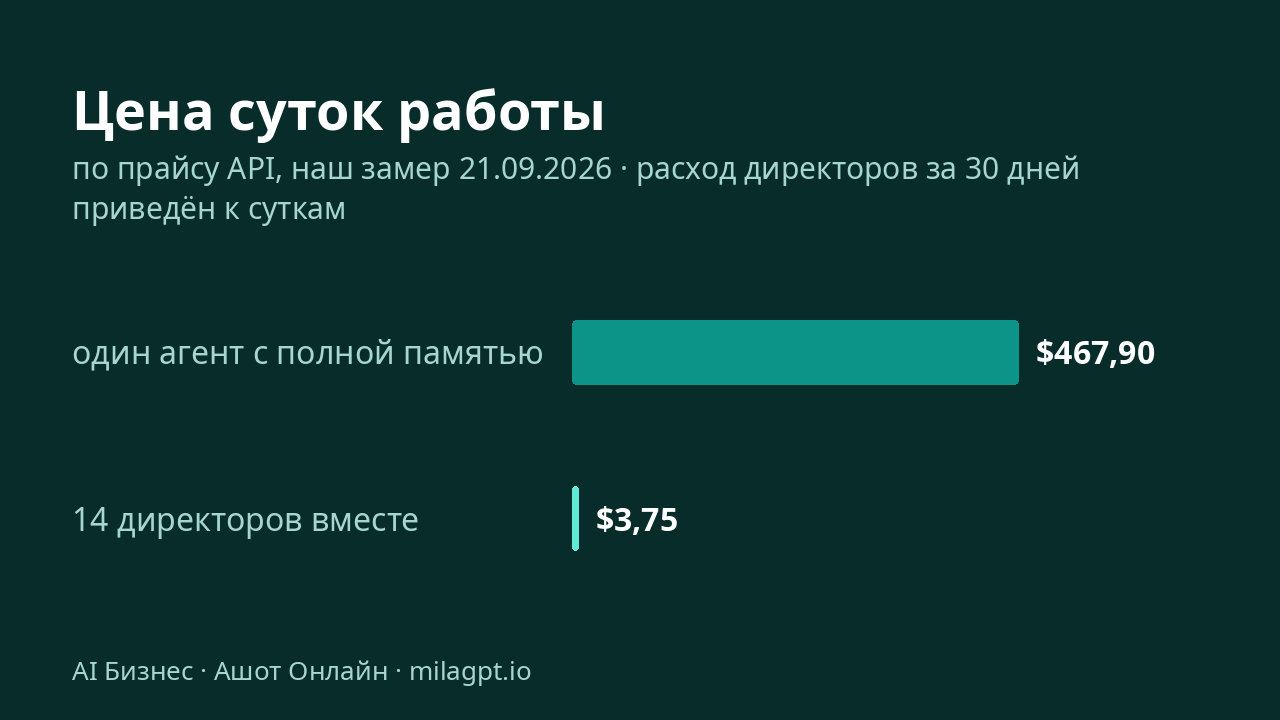
The difference isn't in how smart the model is. A Mila answers a client's question and forgets; an agent with full memory drags the whole history of the business into every step. The cheap deepseek in our log has 61 thousand input tokens per step — that is the conversation's memory, and that is exactly what we pay for.
A conclusion worth money
Cheap AI doesn't mean "take a simpler model". It means "give each agent exactly as much memory and power as its work requires". A short instruction saves more than switching models.
Subscription or tokens: the economics in question
This is the question we explain most often. The difference is simple:
| Subscription | Tokens |
|---|---|
| Counted by people: one person — one subscription | Counted by tasks: you pay for the work, not for a seat |
| A fixed fee, a ceiling on the load | The bill grows with the volume of work |
| Pays off while a person does the work by hand | Pays off when the agent also works at night |
The market has already moved on to a third measure — paying for the result. Fin by Intercom charges $0.99 per resolved conversation, not per seat and not per token: you pay for one outcome per conversation, even if the agent took several actions inside it. Zendesk also counts "automated resolutions", though it doesn't publish the price.
This article came out the day after a price war. On September 22, Anthropic released Claude Opus 5.5 at 20% less than its predecessor, and reading from memory became 60% cheaper at once. The market confirmed the main point: it's not the model that's expensive, it's memory — and memory is getting cheaper fastest of all.
What this means for your business
- Count not the price of the model but the price of one working step — and look at the spread, not the average.
- The fastest way to cut the bill is to shorten memory where it isn't needed.
- Put a large model where a decision is costly, and a small one where a step repeats a hundred times a day.
- Geniuses become available not to those with the bigger budget, but to those who can build a team out of them and give each one its own job.
Want to work this out for your own business?
Write to us — we'll show you what a digital employee would cost in your particular line of work.
t.me/mila_tashkent_botAll figures were checked on September 21–22, 2026: model prices via the OpenRouter catalogue, our spend via billing logs, Fin's price via the vendor's pricing page. Prices change often; if you're reading this much later, check against the original source.